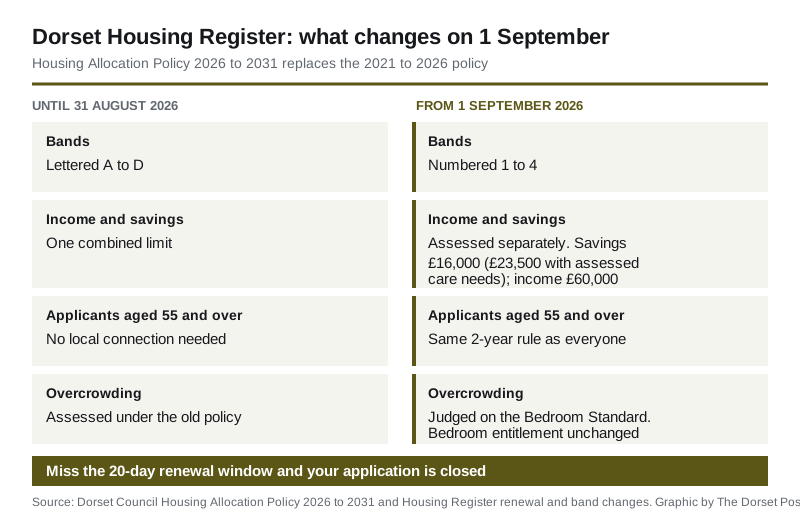

Miss the 20-day renewal window and your application closes. Half of the 6,921 people on Dorset's housing register have not renewed. New bands start 1 September.
Around half of the people on Dorset’s housing register have not yet renewed their application, and the council has asked them to do it now. (Dorset Council, 17 August 2026)
The renewal is not a reapplication. For most people it means confirming that nothing has changed. But it carries a deadline that the council’s press release does not mention, and the consequence of missing it is severe.
The 20-day clock is the part to watch
Dorset Council’s own guidance is blunt about it.
“If you do not complete your renewal within the 20-day timeframe, your application will be closed.”
That is on the council’s Housing Register renewal and band changes page. The council has not published what the 20 days are counted from, and it is not 1 September. Renewal requests have been going out since 1 May, through applicants’ customer portal accounts and by text message.
So the question is not whether you have until September. It is whether a request is already sitting in your portal account.
If you no longer want to be on the register, the council asks you to email dorsetcouncilhomechoice@dorsetcouncil.gov.uk rather than let the clock run out.
Who has to renew
- Most of the 6,921 people on the register when the policy was approved were asked to renew. (Dorset Council, 17 April 2026)
- Anyone who registered after 1 January 2026 does not need to renew. Their details are recent enough that the council will reassess them automatically.
- Anyone joining from 1 September 2026 is assessed under the new policy from the start.
You can carry on bidding for homes while your renewal is being processed. If you are shortlisted for a property before the renewal is finished, the council says it will prioritise your assessment so the nomination still stands.
What actually changes on 1 September
Councillors approved the Housing Allocation Policy 2026 to 2031 at Full Council in April 2026. It replaces the 2021 to 2026 policy and follows a 12-week statutory consultation in summer 2025 that drew 713 responses.
Five things change:
- Bands are renumbered. The old A to D lettering becomes 1 to 4.
- Income and savings are assessed separately. They used to be treated as one combined limit.
- A two-year local connection test applies to almost everyone.
- Applicants aged 55 and over lose their exemption from the local connection rules.
- Overcrowding is assessed differently, although the number of bedrooms you are entitled to does not change.
The council’s warning on the banding is worth reading twice. Some categories have been widened, so more people may end up in the same band. Your position on a shortlist can move even if your priority has not.
The new bands, and what goes in each
The policy sets out four bands in order of preference. Anyone who qualifies for more than one is placed in the higher band. (Housing Allocation Policy 2026 to 2031, section 14)
- Band One, priority housing need: owed a main homelessness duty, priority medical grounds, UK armed forces, fleeing domestic abuse, priority welfare grounds, disaster or emergency.
- Band Two, high housing need: homelessness relief duty, under-occupying social rented housing, overcrowded by two or more bedrooms, foster carers, adopters and care leavers, hardship grounds, giving up accessible housing.
- Band Three, medium housing need: homeless household, homeless prevention duty, social tenants with the right to move, the UK armed forces community, overcrowded by one bedroom.
- Band Four, low housing need: social tenants seeking a transfer, need for older person housing, supported housing where the applicant is not ready to move, reduced preference for 12 months.
Overcrowding is now judged against the UK government’s Bedroom Standard. Exemptions still apply where a household member needs a bedroom of their own.
There is also a limit on refusals that catches people out. Applicants in bands one, two and three may turn down three suitable properties; after the third refusal they drop to Band Four for 12 months. Applicants already in Band Four may refuse once; a second refusal suspends them from the register for 12 months.
The money test
The old policy used a single combined figure for income and savings. The new one splits them.
You may not qualify for the register if:
- your savings are £16,000 or more, rising to £23,500 for adults assessed by Dorset Council as needing care, or
- your gross income is £60,000 a year or more.
The council says most applicants will not have to supply new financial documents unless something has changed significantly.
The two-year local connection test
Most applicants now need to show a two-year connection to the Dorset Council area. The policy accepts three routes:
- living in the area by choice for at least two years
- working in the area for two years or more, for at least 16 hours a week
- close family, meaning adult children, parents, siblings or someone who can reasonably be regarded as close family, resident in the area by choice for at least two years
There are exemptions, including people fleeing domestic abuse and members of the UK armed forces. A local connection only gets you on to the register. It does not give you banding priority.
The change that affects most people is the removal of the over-55 exemption. Applicants aged 55 and over previously did not need a local connection at all. From 1 September they follow the same two-year rule as everyone else, unless exempt through homelessness legislation.
What it means for you
- Log in to your customer portal account and check for a renewal request. Requests have been going out since 1 May, so for a lot of people the 20-day clock is already running.
- If your circumstances have changed since you applied, say so in the renewal. Address, household size, income and employment all feed into your new band.
- Do not stop bidding. The council is explicit that bidding continues through the renewal period, whether or not you have been given your new band.
- If you are shortlisted and your renewal is outstanding, expect to be asked to finish it before the offer can go anywhere.
- If you are 55 or over and moved to Dorset recently, check the local connection rules before September. This is the group whose position changes most.
- If you cannot complete the renewal online, an officer will contact you. Help is also available at dorsetcouncilhomechoice@dorsetcouncil.gov.uk.
Social housing is scarce in Dorset, which is why the paperwork matters. If you are weighing up the private market instead, our Dorset house prices page tracks what homes are actually selling for. Dorset planning news follows the schemes that would add to the supply.
Sources
- Reminder for Housing Register applicants ahead of September policy changes, Dorset Council, 17 August 2026
- Housing Register renewal and band changes, Dorset Council
- Dorset Council Housing Allocation Policy 2026 to 2031
- Councillors endorse Dorset Council’s new housing allocations policy and renewal process, Dorset Council, 17 April 2026
Have your say