
Dorset is due a £145m government grant this month to clear most of its SEND deficit. A council report says the deficit will be back to about £150m by March 2028.
Dorset Council expects a £145 million government grant this month to wipe out most of the debt run up on special educational needs and disabilities (SEND).
But the deficit will climb straight back. A finance report to Dorset’s Schools’ Forum on Friday 6 November forecasts it at about £150 million by 31 March 2028, back where it started.
The grant
Ministers approved Dorset’s Local SEND Reform Plan in October, as we reported. Approval unlocked a one-off High Needs Stability Grant.
The quarter two report now gives the figure: £145m, due in November 2026. The council’s Dedicated Schools Grant (DSG) deficit stood at £148.7m on 31 March 2026, the report says. The gap left over is £3.7m.
That gap will be paid from a reserve the council set up for the Safety Valve programme, a government scheme that was later cancelled. The same reserve is there in case the government does not fully cover future deficits.
Why it comes back
The money clears the debt already built up. It does nothing for this year’s overspend, which keeps growing:
- 2025 to 2026: £54.45m overspent
- 2026 to 2027: £74.3m overspend forecast at the end of September, up £0.58m since June
- 31 March 2027: £76.7m cumulative deficit forecast, even after the grant
- 31 March 2028: about £150m forecast
Almost all of the overspend is in the high needs budget. That pays for education, health and care plans (EHCPs), special schools and specialist placements. The report blames rising demand for EHCPs and specialist places.
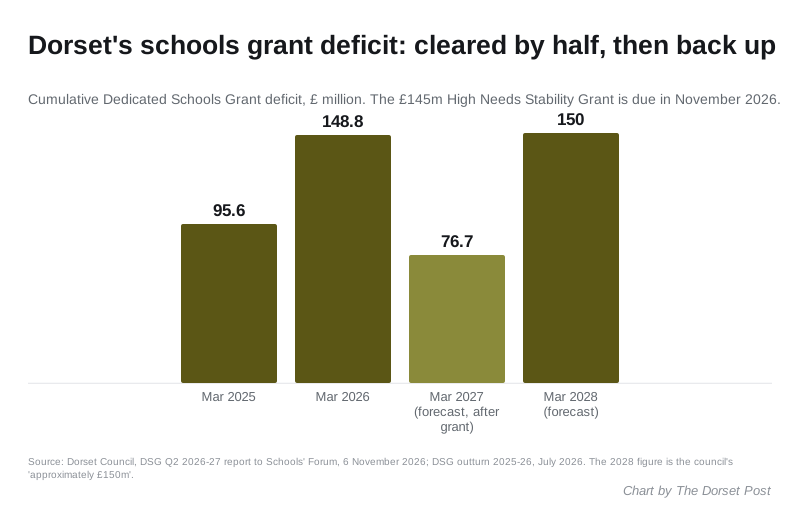
The figures for March 2025 and March 2026 come from the council’s 2025 to 2026 outturn report, taken to the forum in July: £95.6m and £148.8m (£148,768,499). The new report gives the March 2026 figure as £148.7m.
Where the money is going
The biggest single pressure this quarter is independent special schools:
- 342 full-time places forecast, against 330 budgeted
- £68,743 average cost per place, against £66,680 budgeted
- a £1.48m overspend on that line
Some of it is offset. Specialist post-16 places are down to 144 against 155 budgeted, saving £0.647m.
The council also cannot currently report how many EHCPs it has. Its new case management system went live in May 2025. The report says data clean-up and redesigned reports mean “validated EHCP data for the period to the end of September is not currently available”. New reports are due this term.
The cost to the council
The deficit does not sit on the council’s main budget. A legal override keeps it off the books until March 2028. But it still costs money. The report says carrying a £148.7m deficit leaves the council that much less cash, at a cost of about £6m in lost interest.
The grant eases that, but only for a while. The report says the pressure “will return during the later stages of 2026/27 and 2027/28”.
The government has said only that it will take “an appropriate and proportionate approach” to deficits from 2026 to 2028, “though it will not be unlimited”.
What it means for you
- If your child has SEND, none of this changes their entitlement. The council’s legal duty to provide what is in an EHCP stays the same.
- If you pay council tax, the grant removes most of a debt that would otherwise have hit the council’s own budget when the override ends. The forecast shows the risk returning by 2028.
- The next update is the quarter three report, which will add schools’ own autumn forecasts.
Sources
- Dorset Council: Dedicated Schools Grant (DSG) Outturn for 2026-27 Q2, report to Schools’ Forum, 6 November 2026, and the meeting agenda.
- Dorset Council: DSG outturn 2025-26, Appendix A, Schools’ Forum, 3 July 2026, for the March 2025 and March 2026 deficits.
- GOV.UK: Explanatory note on the government’s approach to Dedicated Schools Grant deficits.
Have your say