
About 134,580 homes in the Dorset Council area are in council tax bands A to D, which get the £100 Household Energy Payment from January 2027.
About seven in ten homes in the Dorset Council area are in line for a £100 payment towards energy bills from January. The Chancellor announced the Household Energy Payment in last Wednesday’s Budget.
It goes to households in council tax bands A to D in England. Councils pay it out, so in this area it will come through Dorset Council.
Dorset has a smaller share of homes in those bands than most of England. That matters, because more Dorset households fall outside the scheme.
How many Dorset homes it covers
The Valuation Office Agency’s count of properties by band shows 188,910 homes on the Dorset Council list at 31 March 2026. 134,580 of them, or 71.2%, are in bands A to D.
That compares with:
- 80.8% across England
- 80.4% across the South West
- 79.8% next door in Bournemouth, Christchurch and Poole
Of the 27 councils in the South West, only four have a lower share than Dorset: the Isles of Scilly, the Cotswolds, South Hams and East Devon.
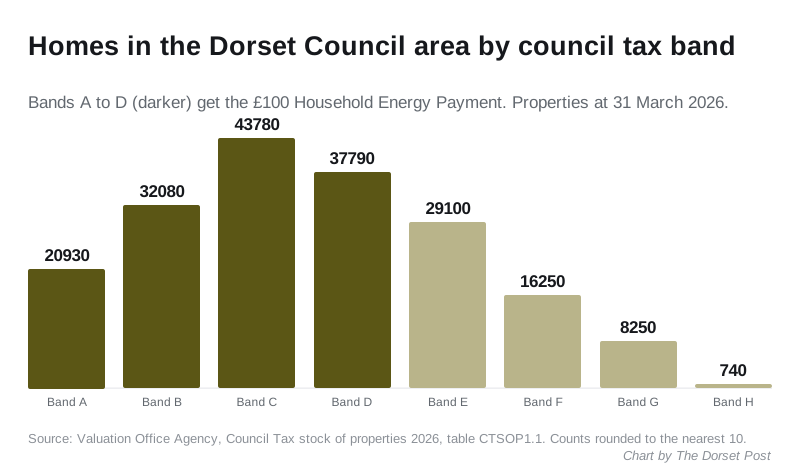
| Band | Homes | Gets £100? |
|---|---|---|
| A | 20,930 | Yes |
| B | 32,080 | Yes |
| C | 43,780 | Yes |
| D | 37,790 | Yes |
| E | 29,100 | No |
| F | 16,250 | No |
| G | 8,250 | No |
| H | 740 | No |
| All bands | 188,910 |
Band C is the biggest single band in Dorset, with 43,780 homes. More than 54,000 Dorset homes are in bands E to H and get nothing from this scheme.
Not every one of those homes will be paid
The count is of properties, not households. The government’s guide to the Budget’s energy measures says the payment goes to people who are liable for council tax on a band A to D property and live in it as their main home. It says:
- second homes are not eligible
- empty properties are not eligible
- households where the householder is not responsible for council tax are not eligible
- most households exempt from council tax will be included
Second homes are a bigger factor in Dorset than in most places. Dorset Council’s return to the government for Council Taxbase 2025 recorded 4,220 second homes in bands A to D on 6 October 2025, out of 5,981 second homes in all bands. None of those 4,220 will get the payment. So the real number of Dorset payments will be lower than 134,580.
Where in Dorset the share is highest
The VOA publishes the same count for small areas of about 2,000 to 6,000 homes. Across Dorset’s 48 areas, the share in bands A to D runs from almost all homes on Portland to a quarter in St Leonards.
The highest shares:
| Area | Homes in A to D | All homes | Share |
|---|---|---|---|
| Southwell and Weston, Portland | 3,550 | 3,630 | 97.8% |
| Westham South, Weymouth | 3,870 | 3,960 | 97.7% |
| Underhill and The Grove, Portland | 2,640 | 2,720 | 97.1% |
| Weymouth Town, Melcombe Regis and Rodwell | 5,530 | 6,020 | 91.9% |
| Broadwey and Littlemoor | 3,330 | 3,650 | 91.2% |
| Wyke Regis | 2,310 | 2,550 | 90.6% |
The lowest shares:
| Area | Homes in A to D | All homes | Share |
|---|---|---|---|
| St Leonards | 930 | 3,680 | 25.3% |
| Parley and Hampreston | 1,730 | 4,630 | 37.4% |
| Sturminster Marshall and Crichel | 1,150 | 2,620 | 43.9% |
| Corfe Castle and Langton Matravers | 1,260 | 2,830 | 44.5% |
| Colehill | 1,350 | 2,860 | 47.2% |
| West Verwood | 1,680 | 3,360 | 50.0% |
In the larger towns, the share is 87.9% in Blandford Forum town, 83.8% in Gillingham, 81.7% in Shaftesbury, 75.0% in Swanage and 74.2% in Sherborne. In Dorchester it is 85.4% in the north of the town and 80.4% in the east.
The area names are the House of Commons Library’s names for these statistical areas, not council wards.
What the government says about the scheme
The guide and the Budget set out:
- £100 per household in bands A to D in England
- paid from January 2027
- up to 20 million households eligible across England
- an extra £100 million for councils to help households outside bands A to D who are struggling with energy bills
A Treasury analysis published on 3 November estimates that households in England will gain about £160 on average from all of its energy support in 2026-27. It puts the gain for the poorest fifth of households at about £230.
What it means for you
- Check your band. It is on your council tax bill, or you can use the government’s band checker. Our Dorset council tax bands page has this year’s bills town by town.
- Pay by Direct Debit? You should not need to do anything. The government says the money will go straight into the bank account you pay from.
- Pay another way? Dorset Council will invite you to apply. It has not yet said how or when.
- Be wary of anyone else asking. The government says nobody other than your council should contact you about claiming it. If a text or call asks for bank details to “release” the payment, check with Dorset Council first.
- Outside bands A to D but struggling? Councils will set their own rules for the £100 million fund. Dorset Council has not yet published its scheme. People on some means-tested benefits may also qualify for the £150 Warm Home Discount.
We will update this page when Dorset Council says how and when it will pay.
Sources
- What the Autumn Budget 2026 means for your energy bills, GOV.UK, 28 October 2026, for eligibility, Direct Debit payments, the warning about contact and the £100 million fund.
- Analysis of the impact of government energy support on household incomes in England, HM Treasury, 3 November 2026, for the average gains.
- Council Tax: stock of properties, 2026, Valuation Office Agency, table CTSOP1.1, for homes by band at 31 March 2026 in Dorset, its 48 small areas, the South West councils and England. Counts are rounded to the nearest 10.
- Council Taxbase 2025 in England, local authority level data, table 1.11, for second homes in Dorset by band at 6 October 2025.
- MSOA names, House of Commons Library, for the area names.
Have your say