
The Boundary Commission proposes 84 Dorset councillors in 58 wards, with most boundaries changing. Residents have until 9 November 2026 to comment.
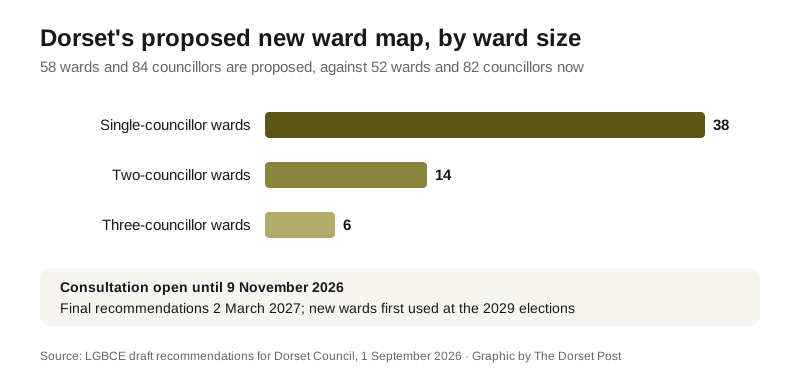
Most of Dorset would vote in a redrawn council ward under proposals published on 1 September. The Local Government Boundary Commission for England wants Dorset Council to have 84 councillors in 58 wards. That is two more councillors and six more wards than now.
Residents have until 9 November 2026 to comment. The Commission says it has an open mind and will consider every piece of evidence it receives.
The draft recommendations propose 38 single-councillor wards, 14 two-councillor wards and 6 three-councillor wards. The Commission is the independent body that draws council ward boundaries, and it is reviewing Dorset at the council’s own request, so that each councillor represents a similar number of electors.
The Commission had originally decided in March that Dorset should keep its 82 councillors. It changed its mind after the council submitted an 84-councillor scheme. In its report, the Commission says the larger number “would allow us to create wards which better reflected community identity and interests”.
What changes, town by town
The full report runs to 54 pages. These are the headline proposals for the main towns:
- Weymouth: the biggest redraw in the county. The three-councillor Rodwell & Wyke ward would split into three single wards, named Sandsfoot, South Harbourside and Wyke Regis. Radipole ward would be replaced by separate Lodmoor and Radipole & Southill wards, with the railway line as the boundary between them. Melcombe Regis would expand to take in the Carlton Road North and Carlton Road South area. Littlemoor and Preston would stay together in one two-councillor ward, despite calls from two councillors to separate them.
- Portland: no change. The island keeps its three-councillor ward, even though it is forecast to have 14 per cent fewer electors per councillor than the Dorset average by 2032. The Commission accepted that Portland’s identity is distinct from Weymouth’s.
- Bridport: one three-councillor ward matching the town council boundary, extended to include the new housing development west of the town, part of which lies in Symondsbury parish.
- Blandford: a new three-councillor ward joining Blandford Forum with Blandford St Mary, Bryanston and Charlton Marshall. The Commission rejected both schemes put to it, including one that would have split the town in two.
- Gillingham: a three-councillor ward focused on the town and its nearest villages. East Stour, Motcombe and West Stour would move to neighbouring wards.
- Sherborne Rural: redrawn to take in Bishop’s Caundle and the Cam Vale parishes, including Longburton.
- Sturminster Newton: the town’s single-councillor ward would add Hammoon and Manston.
- Dorchester: largely as now, with only a minor boundary adjustment between Dorchester East and Dorchester West. Poundbury keeps its own ward.
- Shaftesbury: the two-councillor town ward is unchanged.
What it means for you
- The outcome decides which ward you vote in, which communities share your councillors, and in some cases which parish ward you are in. Ward names may change too.
- Nothing changes at the ballot box until 2029. After the final recommendations are published on 2 March 2027, Parliament must approve them, and the new wards would first be used at the all-out Dorset Council elections in 2029.
- The Commission is explicit that the review cannot change postcodes, council tax or house prices. Our Dorset council tax bands page covers what actually sets your bill.
- To comment, use the interactive map and response form at lgbce.org.uk/all-reviews/dorset, email reviews@lgbce.org.uk, or write to Review Officer (Dorset), LGBCE, 7th Floor, 3 Bunhill Row, London EC1Y 8YZ. The Commission publishes all submissions it receives.
- Evidence beats opinion. The Commission asks respondents to say why a boundary is right or wrong: community groups, transport links, shared facilities and identifiable boundaries all count.
Launching the consultation, Bev Smith, chair of the Commission, said: “Whether you agree with our proposals or think something should change, please let us know. Every response helps us make better decisions.”
Sources
- Dorset Council review page and draft recommendations, Local Government Boundary Commission for England, 1 September 2026
- New electoral arrangements for Dorset Council: draft recommendations, full report (PDF), LGBCE, September 2026
- Have your say on a new political map for Dorset Council, Dorset Council, 1 September 2026
Have your say