
The Environment Agency has let Powerfuel Portland burn 67 more types of waste, including household rubbish, at its planned plant. The 202,000-tonne cap stays.
The planned incinerator at Portland Port can now burn a much wider range of waste. The Environment Agency has approved a change to its permit, after Dorset Council, both town councils and the MP for South Dorset raised concerns.
The Agency announced the decision on 12 October. It says it is satisfied there will be “no significant impact on the environment or harm to human health”.
What has changed
The operator is Powerfuel Portland Limited. Its variation notice adds 67 waste codes to the list of what the plant may burn. The permit’s list now runs to 69 codes.
They include, among others:
- mixed municipal waste, the ordinary contents of a household bin
- bulky waste
- paper, plastic, wooden and mixed packaging
- clothes and textiles
- wood, plastics and paper and card
- waste from food processing, farming and forestry
The Agency’s decision document says the plant will burn municipal waste and non-hazardous commercial and industrial waste. It says all the added types are non-hazardous.
What has not changed
The Agency says the variation does not change:
- the maximum amount burned, 202,000 tonnes a year
- the emission limits or the monitoring
- the buildings, the operating hours or the site boundary
- the number of lorry movements on site, according to the operator
The new wastes arrive by road and go straight into the bunker, inside an enclosed building kept at slightly lower pressure to hold in smells and dust. The bunker holds up to about three days of waste.
The plant in numbers
The Agency still calls it a proposed facility. The permit describes it as:
| Capacity | 202,000 tonnes of waste a year |
| Furnace | One line, moving grate |
| Chimney | 80 metres |
| Electricity | 18.1 megawatts |
| Heat | Designed to export about 11 megawatts to local users |
Planning permission was granted by the government on 16 September 2024, the decision document records. The Agency notes that planning and permitting are separate, and that it cannot consider where the plant is or the traffic it brings.
Who raised concerns
The Agency consulted on its draft decision from 19 June to 31 July 2026. It received approximately 296 comments.
Representations came from:
- Dorset Council
- Weymouth Town Council and Portland Town Council
- the MP for South Dorset
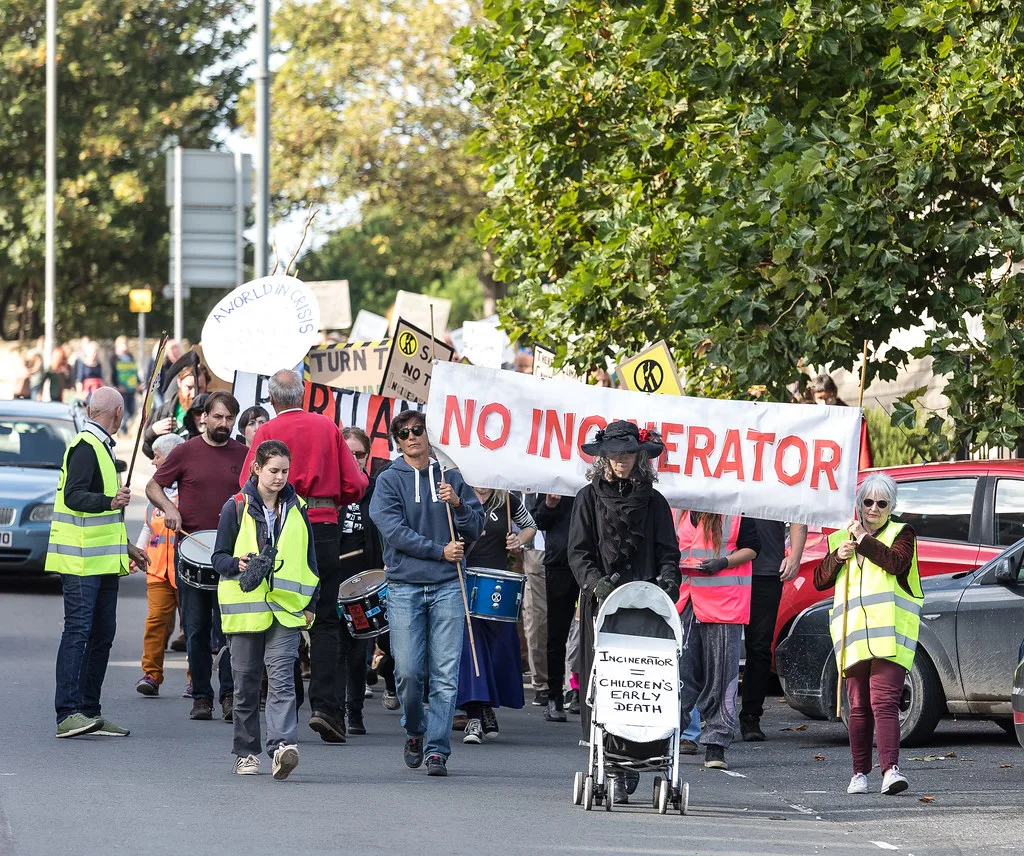
- the Stop Portland Incinerator Campaign
- groups including the Wyke Regis Society, Nothe Fort, Dorset CPRE, the Portland Association, Friends of Castle Cove Beach and Friends of the Rodwell Trail and Sandsfoot Castle Gardens
Concerns included air quality, health, smell, noise, pests, litter reaching the sea and fire risk.
How the Agency answered
The decision document answers each concern in turn. Among its answers:
- Air. Burning the extra types will not change the gases leaving the chimney, so the air quality modelling from the original permit still stands, the Agency says.
- Health. It cites the UK Health Security Agency’s view that modern, well-run incinerators are not a significant risk to public health. It adds that adverse effects cannot be ruled out completely, but any effect for people nearby “is likely to be very small”.
- A new school. The new special educational needs school was not assessed specifically, because it was not identified when the original permit was granted. The Agency says its modelling showed no unacceptable impact anywhere.
- Fire. The operator had to send an updated fire prevention plan. The Agency says the plan is acceptable in principle and has added a condition requiring it to be confirmed once the plant is designed in detail.
- Smell and litter. Waste must arrive in enclosed or covered lorries or sealed containers.
- Traffic outside the site is not something a permit can control.
The Agency says it can only refuse a permit if the legal requirements are not met. “If all the requirements are met, the Environment Agency is legally obliged to issue a permit,” it says.
What it means for you
- No date for the plant yet. The permit is in place, with conditions the operator must meet before the plant can start. No opening date has been published.
- You can read everything. The full permit, the decision document and the consultation responses are on the Agency’s public register.
- Problems once it runs. The Agency says notices of abnormal operation will be published on its public register, open to the council and the public.
Sources
- Environment Agency: permit variation for Powerfuel Portland, 12 October 2026, for the decision, the consultation dates, the approximately 296 comments and the Agency’s statement.
- Environment Agency: Portland Powerfuel Limited variation notice, EPR/AP3304SZ/V002, 12 October 2026, and the variation notice and consolidated permit, for the 67 added waste codes, the capacity, the chimney height and the generating capacity.
- Environment Agency decision document, for the unchanged limits, the consultees, the objectors, the Agency’s answers and the 16 September 2024 planning permission.
Have your say