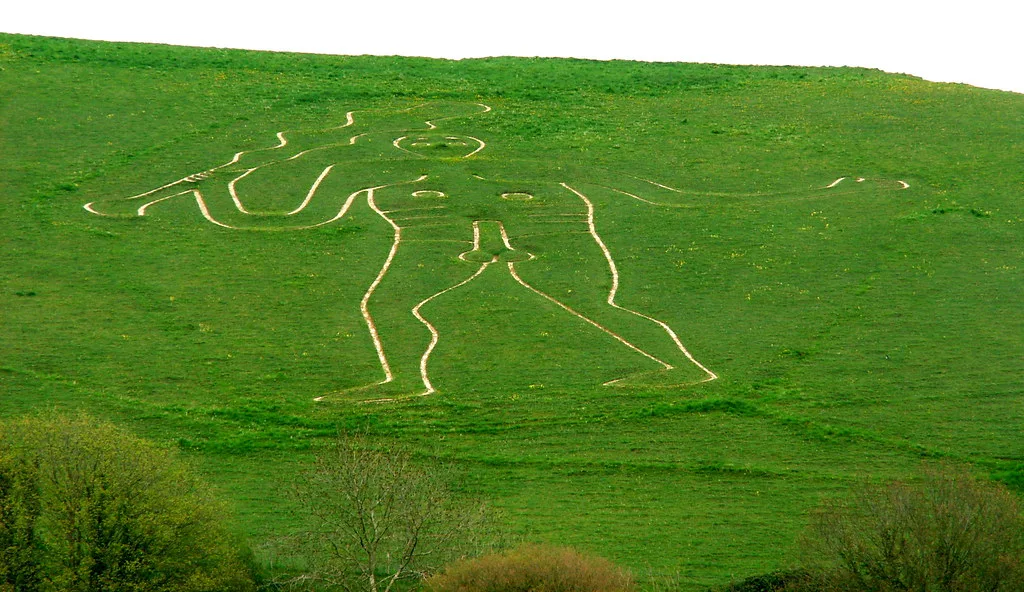

The Cerne Abbas Giant is best seen from the National Trust viewing area, not the A352 lay-by. The walk, the bus, dogs, and the 2021 late Saxon dating.
The Cerne Abbas Giant is a 180ft figure cut into the chalk of Giant Hill above Cerne Abbas, eight miles north of Dorchester, and the National Trust calls it Britain’s largest chalk hill figure. It is free to see and open from dawn to dusk. The main thing visitors get wrong is where to stand: the free lay-by on the A352 that most people pull into gives only a limited view, and the Trust says the best view is from the viewing area by its car park. You cannot walk on the giant itself.
Here is where to look from, how to get there without a car, the walk up the hill, and what the 2021 dating actually found.
Where to see the giant from
The viewing area and car park. The National Trust’s car park is on flat tarmac, with one accessible space, and its viewing area “offers the best view of the giant”, in the Trust’s words. Use DT2 7AL for the village; the site is signposted just off the A352.
The A352 lay-by. Free and not run by the Trust, and the obvious place to stop if you are driving past. The Trust says it “provides a limited view” and suits coaches, but “may not provide the best perspective”. Fine for a glance; not where to take your photograph.
The hills around the village. The Trust suggests the surrounding hills for a better vantage point than the lay-by.
If the giant looks faint, that is deliberate rather than neglect. The Trust says part of looking after him is leaving the ground alone as much as possible, because the more it is disturbed the faster the figure erodes, and the chalk is only replaced every decade or so, a job that takes rangers and volunteers several days.
The walk
From the centre of Cerne Abbas it is, in the Trust’s words, “a gentle ¼ mile walk” along a signposted footpath to the viewing area. Beyond that the hillside is steep, a mix of grass and chalk, and very muddy after rain. Access to the figure itself is restricted to stop erosion, so the walk up Giant Hill takes you around and above him rather than across him.
At the top is the Trendle, a rectangular earthwork believed to date from the Iron Age, which local Morris dancers still use for their May Day celebrations. The Wessex Ridgeway long-distance path, which runs from Marlborough to Lyme Regis, passes a mile away and links up by footpaths and quiet lanes if you want a longer day. Our walks in Dorset guide includes the giant among twelve walks across the county.
Dogs are welcome but must be on a lead. The chalk grassland around the giant is of national and European importance for its rare downland plants and insects. Look for marsh fritillary butterflies in May and wild flowers through the summer.
Getting there
- By car: signposted off the A352, 8 miles north of Dorchester and 10 miles south of Sherborne.
- By bus: Damory Coaches’ 216 between Dorchester and Sherborne stops at the giant’s viewing area and car park and in Cerne Abbas village. It runs on weekdays only, so there is no bus at weekends.
- By train: the nearest station is Maiden Newton, 6 miles away; Dorchester South and Dorchester West are both 8 miles.
- By bike: National Cycle Network route 26 between Castle Cary and Dorchester. From Dorchester the Trust describes the 8 miles to Cerne Abbas as a quiet but rough and uneven road.
How old is the giant?
For centuries nobody knew. Theories ranged from a prehistoric fertility figure to a portrait of the Greco-Roman hero Hercules to a 17th-century joke at Oliver Cromwell’s expense. In 2021, a century after the giant was given to the National Trust in 1920, the Trust’s senior archaeologist for Wessex, Martin Papworth, led a project to settle it.
The team took soil samples from the giant’s feet and elbows for optically stimulated luminescence (OSL) dating, which shows when grains of sand were last exposed to sunlight. Professor Phillip Toms of the University of Gloucestershire analysed them. The deepest material gave a date range of AD 700 to 1100, and the Trust concluded the giant was “probably first constructed in the late Saxon period”. That rules out a prehistoric or Roman origin, and it also rules out the Cromwell theory as the date of first construction. Snail shells recovered from the figure included species thought to have reached Britain in the medieval period, which fits.
Two questions stay open. Papworth’s working theory is that the giant was made in the late Saxon period, then grassed over and forgotten for centuries before being found and recut. And the dating does not tell us whether the design has changed since it was first made, so the figure you see today may not be the one first cut.
The same method has dated other hill figures very differently: the Uffington White Horse in Oxfordshire to the late Bronze Age or early Iron Age, and the Long Man of Wilmington in Sussex to the Tudor period.
The abbey and the village
The village takes its name from Cerne Abbey, a Benedictine monastery that Dorset Council’s historic environment record says was founded or refounded in 987, with evidence of an earlier one from the late ninth century. Little survives: the Abbot’s Porch, the Guest House and a barn, in the grounds of the privately owned Abbey House, which also contains part of the abbey’s south gatehouse. In a corner of the churchyard is St Augustine’s Well, ringed by lime trees.
Cerne Abbas is worth an hour on its own. The Royal Oak in the village is in our guide to Dorset pubs, and the village has a brewery of its own whose beer turns up on local handpumps. For more ideas nearby, see things to do in Dorset.
Frequently asked questions
Where is the best place to see the Cerne Abbas Giant? From the National Trust viewing area by its car park, which the Trust says gives the best view. The free lay-by on the A352 gives only a limited view. The hills around the village are good too.
Can you walk on the Cerne Abbas Giant? No. Access to the figure is restricted to stop erosion. You can walk up Giant Hill around it and to the Trendle earthwork above, but the slope is steep and very muddy after rain.
How old is the Cerne Abbas Giant? National Trust archaeologists concluded in 2021 that it was probably first made in the late Saxon period. OSL dating of the deepest soil gave a range of AD 700 to 1100.
Is the Cerne Abbas Giant free to visit? Yes. It is open from dawn to dusk with no entry charge. The A352 lay-by is free; check the National Trust car park for any parking charge before you go.
Can you get to the Cerne Abbas Giant by bus? Yes, on weekdays. The Damory Coaches 216 between Dorchester and Sherborne stops at the viewing area and in the village. There is no weekend service.
Are dogs allowed at the Cerne Abbas Giant? Yes, but they must be kept on a lead.
Sources
National Trust, Cerne Giant visitor page (opening times, parking, access, directions, conservation) read 6 November 2026; Current Archaeology / The Past, “Latest dating evidence for the Cerne Abbas hill figure” (June 2021); National Trust 2021 dating announcement as reported; Dorset Council historic environment record MDO700 and MDO701 for Cerne Abbey.
Have your say