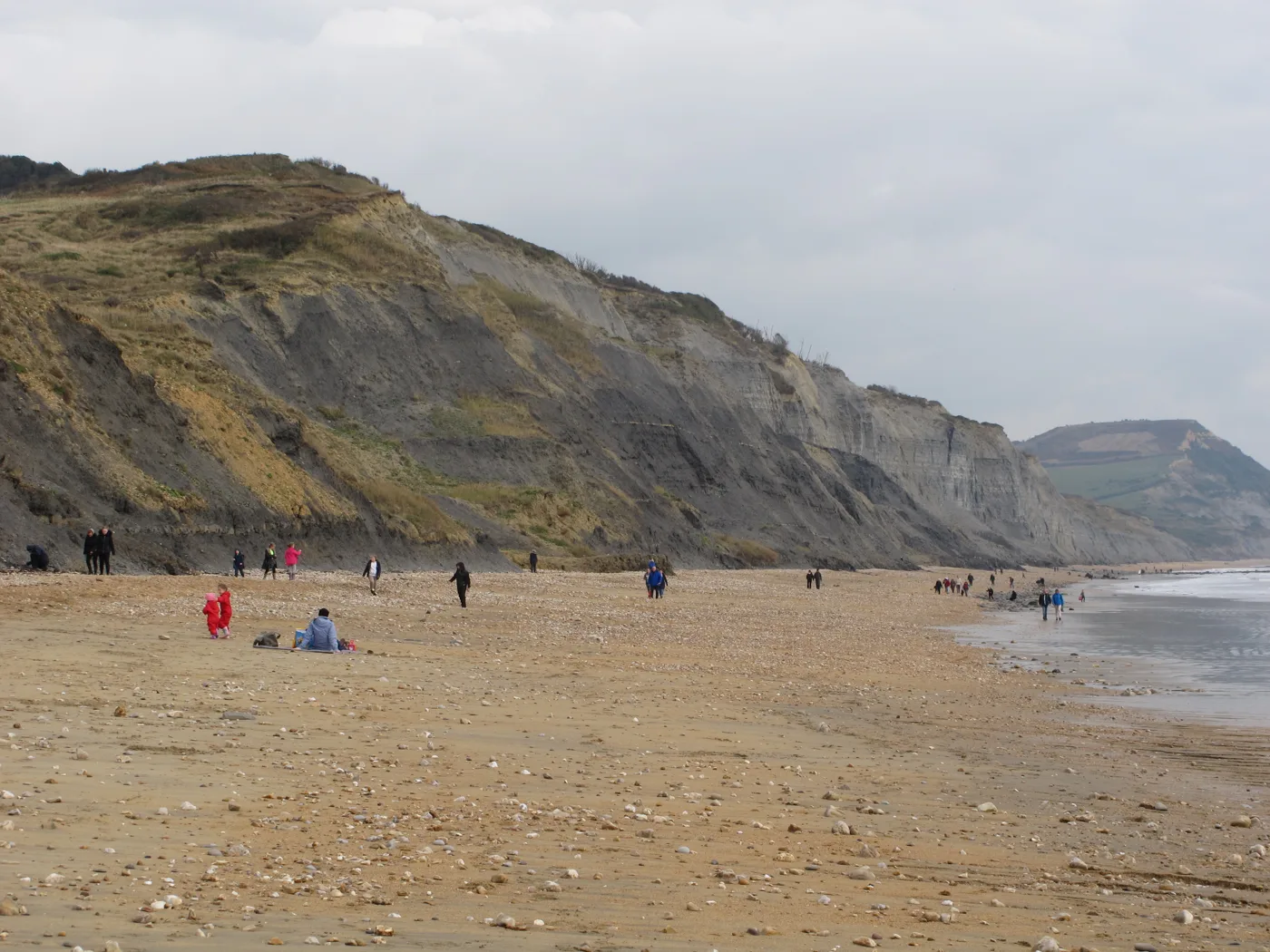

Charmouth fossil hunting works best on a falling tide after winter storms. Search the loose shingle, not the cliffs; record rare finds at the centre.
Charmouth fossil hunting is about as close to a sure thing as fossil hunting gets. The cliffs either side of the River Char are made of Lower Jurassic clays and limestones that the sea eats away every winter, and the fossils they hold wash out onto the beach. You do not need a hammer, a permit or any experience. You need a falling tide, a good pair of boots, and the sense to look in the loose shingle rather than at the foot of the cliffs.
The best months are the ones most visitors avoid. Winter storms and landslides bring down fresh material, so the weeks from November to March, and the days straight after a big blow, give the richest pickings. This page sets out when to go, where to look, what you will find, and the collecting code that applies to this stretch of coast.
When to go: tide and weather
Go on a falling tide. The West Dorset Fossil Collecting Code puts this first in its safety advice: consult the tide times before you set out, and collect while the tide is going out. That gives you the most beach for the longest time, and fresh material is left behind as the water drops. Use a tide table for Lyme Regis or Charmouth, and plan to be heading back well before low water turns.
Go after rough weather. High erosion rates, particularly in winter, are what keep the supply going. After storms, scan the high-tide line and the patches of grey clay and gravel spread across the sand.
Tell someone where you are going and when you expect to be back. The code asks for this too.
Where to look
The Charmouth Heritage Coast Centre is blunt about it: “The best place to look for fossils is in the loose material on the beach and NOT in the cliffs.”
- East beach, towards Stonebarrow and Golden Cap: the classic spot for small ammonites and belemnites in the shingle and on the shelves of clay.
- West beach, towards Black Ven and Lyme Regis: Black Ven is one of the largest active landslides on this coast, and it is also its most dangerous section. Stay on the open beach and well away from the mudflows.
- Patches of fine shingle and pyrite-rich gravel where the waves have sorted the beach: small, heavy, dark pebbles here are often fossils.
Get down low and look closely. Most finds at Charmouth are small, and the people who find the most are the ones who walk slowly.
What you will actually find
| Fossil | What it looks like | How common |
|---|---|---|
| Belemnites | Bullet-shaped, glassy brown or amber, from a squid-like animal | Very common |
| Ammonites | Coiled shells, often small and preserved in brassy pyrite or as dull grey stone | Common |
| Crinoid stems | Star or button-shaped segments from sea lilies | Common |
| Ichthyosaur and fish remains | Odd vertebrae or bone fragments | Occasional |
| Complete marine reptiles | Rare, and usually found by experienced collectors | Rare |
Pyrite ammonites look wonderful when you find them but can crumble over time if they are left in damp air (“pyrite decay”). Ask the wardens at the Heritage Coast Centre how to keep them dry; they will also identify anything you find.
The collecting code: what it asks of you
The West Dorset Fossil Collecting Code of Conduct covers National Trust and Charmouth Parish Council land between Lyme Regis and Hive Beach at Burton Bradstock. It was developed in the late 1990s, revised in 2013 and amended in 2022 to 2023. Natural England runs a separate code for the Undercliffs National Nature Reserve west of Lyme Regis. The headlines:
- No digging into the cliffs without the landowner’s permission. The code says its safest advice, especially for beginners and school groups, is to stay on the beach.
- Do not climb the cliffs or use ropes to reach a particular level, under any circumstances.
- Keep clear of rockfalls and mudflows, including the seaward edges, which can be hidden under shingle and are “particularly treacherous”.
- Wear safety goggles if you use a hammer on a loose rock on the beach.
- Record important finds. The code has two categories. Category 1 covers key scientific finds such as possible new species, extremely rare fossils such as the dinosaur Scelidosaurus, and exceptionally preserved specimens; these must be recorded at the Heritage Coast Centre. Category 2 covers reptile and fish remains, nautiloids, certain ammonites and unusual groups of fossils, and recording them is strongly recommended. Recorded specimens are handed back.
Small and common finds are yours to take home. Collectors who follow the code are given ownership of what they find on National Trust, parish council and Natural England land; anyone wanting to sell an important fossil must offer it to an accredited UK museum first. The code warns that people who dig in the cliffs or fail to record Category 1 finds “may be regarded as stealing the fossils”.
The full text is on the Charmouth Heritage Coast Centre’s collecting code page, and important finds can also be logged online at fossilcodes.org.
Guided fossil walks
The Heritage Coast Centre runs public fossil hunting walks with its wardens through the year. Each walk lasts an hour and a half, entirely outdoors on the beach, and anything you find is yours to keep. The centre lists the charge as £14 for adults and £8 for children, and every child must be with a paying adult. You meet at the red lifebuoy outside the centre; your warden wears a blue high-visibility jacket. Before the walk you are emailed an introductory video, which often lands in junk mail. Dates are on the centre’s events calendar and walks fill up in holidays.
Expect sand, pebbles, boulders and some very muddy patches. Wear boots with a good grip, dress for the weather, and take water: the centre points out there is no shelter on the beach and you will be some way from the café.
The Heritage Coast Centre
The centre sits right on the beach at Lower Sea Lane, Charmouth, DT6 6LR, in the upper floor of an old cement factory built in 1854. Entry is free, with donations welcome; it welcomes more than 100,000 visitors a year. Inside are fossil displays, marine tanks, a video microscope and a short film in its Jurassic Theatre, and a warden or volunteer can identify your finds. It has ramp access. Opening times change with the season, so check before a winter visit (01297 560772).
The building’s future is changing too. Erosion is expected to claim the site by about 2055, and in October 2026 Dorset Council’s Cabinet backed government funding for Charmouth Parish Council to buy Hensleigh House in the village as the centre’s future home. Our story on the Charmouth Heritage Coast Centre’s planned move has the details.
Parking and getting there
Lower Sea Lane runs from the village down to the beach. There are two car parks at the bottom: Dorset Council’s Lower Sea Lane car park and the parish council’s foreshore car park by the beach. Both charge, with different rates and permits, so check the signs on the day. In summer they fill early. Charmouth is just off the A35 between Bridport and Lyme Regis.
Dogs are allowed on Charmouth’s east beach all year; our page on Dorset dog-friendly beaches has the summer rules for the rest of the coast. For the story of the coast’s most famous collector, who worked these same beaches two centuries ago, read our piece on Mary Anning.
Frequently asked questions
When is the best time for Charmouth fossil hunting? On a falling tide, and ideally in winter or just after a storm, when fresh material has come down from the cliffs. Check a tide table for Lyme Regis or Charmouth before you go.
Can you keep fossils you find at Charmouth? Yes. Small and common fossils are yours to take home. Scientifically important finds (Category 1 in the code) must be recorded at the Charmouth Heritage Coast Centre, after which they are handed back to you.
Is it legal to dig in the cliffs at Charmouth? Not without the landowner’s permission. The West Dorset collecting code bans digging into the cliffs and climbing them, and the cliffs are prone to sudden falls and mudflows.
What fossils can you find at Charmouth? Mostly belemnites, small ammonites (often in pyrite) and crinoid stems. Ichthyosaur bones turn up occasionally, and complete marine reptiles are rare.
Do you need a hammer to find fossils at Charmouth? No. Most fossils are found loose in the shingle. If you do split a loose rock on the beach, the code advises wearing safety goggles.
How much is a guided fossil walk at Charmouth? The Heritage Coast Centre lists its public walks at £14 for adults and £8 for children, lasting an hour and a half. Book through the centre’s events calendar.
Have your say