

Men in central Weymouth can expect 58.7 years of good health, against 72.9 in Colehill. Dorset people spend about 16 to 19 years in poorer health.
A boy born in central Weymouth can expect 58.7 years in good health. In Colehill, near Wimborne, the figure is 72.9 years. That is a gap of 14.2 years inside the same council area.
The figures are in a new Healthy Life Expectancy report by Dorset Council’s public health team. It went to the Health and Wellbeing Board on Wednesday 18 November, which was asked to note it and approve its publication.
Overview
- Dorset men can expect 65.3 years in good health and 81.1 years of life (2022 to 2024). That leaves 15.8 years in poorer health.
- Dorset women can expect 65.6 healthy years and 84.8 years of life. That leaves 19.2 years in poorer health.
- England is worse on both: 60.9 healthy years for men and 61.3 for women.
- Inside Dorset, men’s healthy years run from 58.7 in central Weymouth to 72.9 in Colehill. For women the range is 61.2 to 76.2.
- Weymouth and Portland hold seven of the nine Dorset neighbourhoods in England’s most deprived fifth.
What healthy life expectancy measures
Healthy life expectancy is the number of years a newborn can expect to live in good health, as people describe their own health. It is not the age at which someone falls ill. The report notes that people move between good and poor health through their lives, and someone with a well-managed condition can still call their health good.
The county figures come from the Office for Health Improvement and Disparities Fingertips tool. They are estimates with wide margins of error at council level, so small year-to-year changes should be read with care.
Dorset does better than England overall
Dorset residents live longer and stay well for longer than the England average. The table uses the 2022 to 2024 figures.
| Life expectancy | Healthy life expectancy | Years in poorer health | |
|---|---|---|---|
| Dorset men | 81.1 | 65.3 | 15.8 |
| Dorset women | 84.8 | 65.6 | 19.2 |
| England men | 79.5 | 60.9 | 18.6 |
| England women | 83.3 | 61.3 | 22.0 |
The England figures for 2022 to 2024 are the lowest since the series began in 2011 to 2013, the report says. Dorset’s estimates rose on the year before, from 63.9 years for men and 63.7 for women in 2021 to 2023.
Women in Dorset live 3.7 years longer than men, but have only 0.3 more years in good health. The report says the estimates are too uncertain to read that as a precise difference.
The gap between Weymouth and Dorchester
The report compares central Weymouth with Dorchester East, about eight miles north. The Census-based figures cover 2019 to 2023.
- Men: 58.7 healthy years in Weymouth Town, Melcombe Regis and Rodwell, against 68.6 in Dorchester East. A gap of 9.9 years.
- Women: 61.2 against 71.0. A gap of 9.8 years.
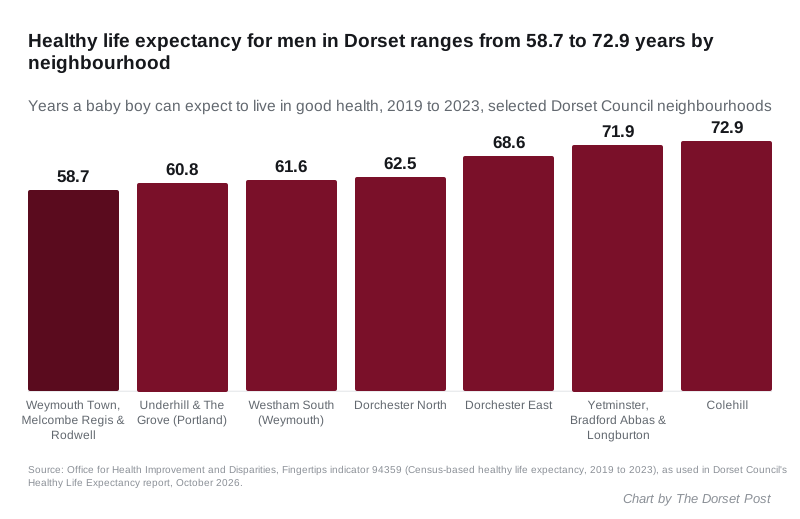
The same national data, published for all 48 Dorset Council neighbourhoods, shows how wide the spread runs. The lowest figures for men are:
- Weymouth Town, Melcombe Regis and Rodwell: 58.7 years
- Underhill and The Grove, on Portland: 60.8 years
- Westham South, Weymouth: 61.6 years
- Dorchester North: 62.5 years
The highest are Colehill at 72.9 years and Yetminster, Bradford Abbas and Longburton, near Sherborne, at 71.9. For women, Colehill is highest at 76.2 years and central Weymouth lowest at 61.2.
Why the gap exists
The report links poorer health to deprivation, long-term conditions and the conditions people live in. Dorset’s 2025 deprivation data puts nine of its 223 small neighbourhoods in the most deprived fifth of England:
- seven in Weymouth and Portland
- one in Bridport
- one in Ferndown
Across England, people in the most deprived tenth of areas spend about 23 years (men) and 30 years (women) outside good health. In the least deprived tenth it is 14 and 18.
The report also sets out Dorset figures from the NHS and council’s shared data service:
- Cancer: about 59% of cancers that can be staged were found early, at stage 1 or 2, between April 2022 and March 2024. For men it was 52%, for women 67%.
- Diabetes: the published needs assessment puts prevalence at 8.0% in the Weymouth and Portland GP network, 7.4% in the Vale and 7.3% in Blandford.
- Falls: of about 115,090 people aged 65 and over registered with a Dorset GP, about 7% were recorded as having fallen in the 12 months to October 2026. There were almost 13,200 fall-related 999 calls and 2,200 hospital admissions. Weymouth and Portland accounted for one fall in five.
- Weight: more than half of residents are overweight or obese, and around one in nine show signs of mild frailty.
What the council wants to do
The report lists six priorities for the council, the NHS and voluntary groups:
- promote active ageing and independent living
- reduce the impact of muscle, bone and joint conditions
- expand falls prevention
- increase walking, cycling and everyday movement
- improve uptake of screening and early diagnosis
- find undiagnosed high blood pressure, through NHS Health Checks and neighbourhood services
It names existing schemes it wants to build on, including Age Friendly Dorset, Healthy Homes Dorset, Thriving Communities and LiveWell Dorset.
What it means for you
- If you are aged 40 to 74 and have not been diagnosed with heart disease, stroke, diabetes or kidney disease, you can have a free NHS Health Check every five years. It checks blood pressure, which the report says is going undiagnosed in parts of Weymouth and Portland.
- Go to your cancer screening appointments when invited. The report says men in Dorset are less likely than women to have cancer found early.
- LiveWell Dorset is the council’s free service for help to stop smoking, lose weight, drink less or get more active.
- The report asks residents to stay active and keep up their strength and balance, which lowers the risk of a fall in later life.
Have your say