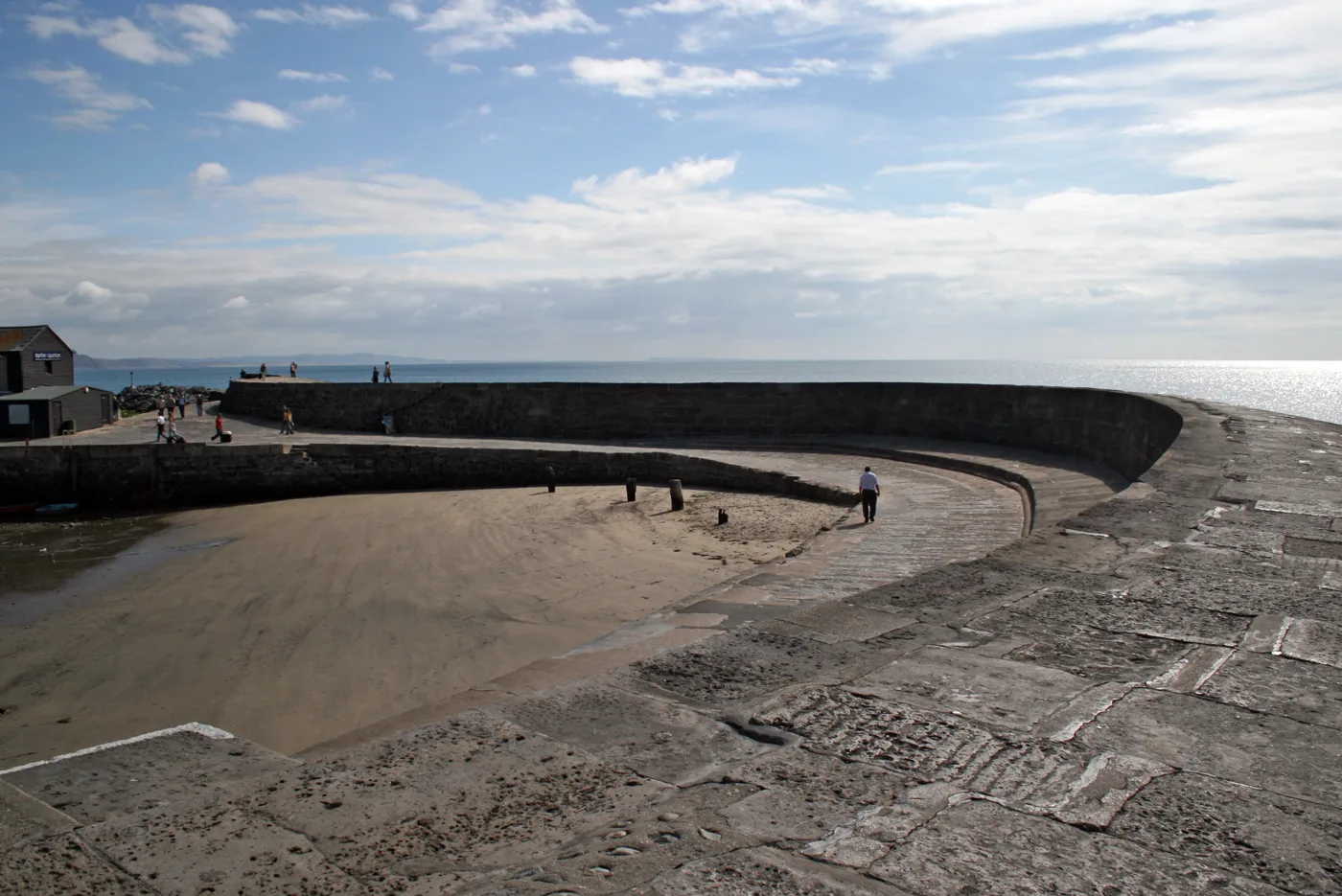

The Cobb at Lyme Regis is a Grade I listed harbour wall with no railings. How to walk it safely, Granny's Teeth, the car parks and the beaches either side.
The Cobb at Lyme Regis is the curved stone harbour wall that has sheltered the town’s boats for centuries, and it is one of the most photographed places on the Dorset coast. It is also a working sea defence with no railings, a sloping and often wet top, and the open sea on one side. Walk it on a calm day and it is one of the best short walks in the county. Walk it in a south-westerly gale and it is genuinely dangerous.
This page covers what the Cobb is, how to walk it safely, Granny’s Teeth and the Persuasion steps, the repair work going on, where to park, and the beaches either side, including the dog rules.
What the Cobb is
Historic England lists the Cobb as Grade I, the highest grade, under the entry “The Cobb Piers and Walls Including North Wall” (first listed in 1952). The listing describes a stone sea wall of medieval origin: the Cobb appears in a 16th-century sketch, and until the end of the 18th century it was dry-built, with no mortar. A small section of that old walling survives in the east face of the Victoria Pier. The wall was completely rebuilt between 1783 and 1829, much of it after the great gales of 1824 destroyed large parts of it. The Victoria Pier was added between 1842 and 1852, and the North Wall in 1849.
The result is two levels. The upper Cobb is the high, curving outer wall, with a broad but sloping and uneven stone top. The lower Cobb is the walkway on the harbour side, sheltered by the upper wall, with the boats, the Lyme Regis Sailing Club buildings and the Marine Aquarium.
Granny’s Teeth and the Persuasion steps
Granny’s Teeth are the stones set into the harbour face of the upper wall, jutting out one above another to make a steep set of steps between the upper and lower Cobb. They are the steps most visitors connect with Jane Austen’s Persuasion, in which Louisa Musgrove jumps from the Cobb steps into Captain Wentworth’s arms, misses and is knocked unconscious. The Cobb also played a starring role in the 1981 film The French Lieutenant’s Woman.
The steps are narrow, have no handrail and are worn smooth. Take a photograph from the bottom if you like, but if you are unsteady on your feet, or carrying a child or a dog, use the slope at the landward end of the Cobb to get between the two levels instead.
How to walk the Cobb safely
The upper Cobb has no railing on either side, and its top is sloping and uneven. When waves wash over it, the stone stays wet and slippery long after the sea has calmed. Lyme Regis Town Council’s winter safety advice is blunt: if you are tempted to watch or photograph waves breaking against harbour walls, you are probably standing too close, and large waves can throw shingle and debris with real force.
- Check the forecast and the sea. On a rough day, with waves breaking over the outer wall, stay on the lower Cobb or the beach. Never walk the upper Cobb to watch a storm.
- Look at the surface. Green weed and standing water mean slippery stone. Wear shoes with grip, and keep to the middle of the walkway.
- Hold on to children and keep dogs on a lead. The Cobb is an on-lead area for dogs, along with the harbour and Marine Parade. A sudden lurch towards the edge is the main risk.
- Watch for closures. Parts of the Cobb are closed from time to time for repairs and in bad weather. Obey any barrier or sign.
- If someone goes in the water, call 999 and ask for the Coastguard. Do not go in after them.
The repair work
The Cobb is under pressure from the sea. In October 2025 the town council reported that a void had been found at the base of the wall and needed urgent repair before the storm season, and warned that without intervention the Cobb’s role as a breakwater could end in the 2040s. Attempts to fill it were thwarted by weather and shingle until a calm low spring tide on 15 and 16 June 2026, when Dorset Council’s engineers installed a concrete-filled mattress to secure the base. Dorset Council says the area will keep being monitored, and that it is working with Historic England, Natural England and the Environment Agency on a longer-term stabilisation scheme. Follow the Dorset Council news page for updates on works and any closures.
The beaches either side
Front Beach (Town Beach) is the sandy beach between the Cobb and the town, sheltered by the harbour wall and the best for small children. Dogs are banned from 1 May to 30 September and allowed from 1 October to 30 April.
Monmouth Beach runs west from the Cobb towards Devon. It is shingle and rock, dogs are allowed all year, and at low tide the ledges at its far end reveal the ammonite pavement, a limestone bed packed with large fossil ammonites. The Lyme Regis Discovery Trail’s advice is to check the tide times before setting out: the far end of the beach is cut off as the tide comes in, people have had to be rescued from the pavement, and the cliffs behind are an active landslip. Stay away from the foot of the cliffs and turn back with plenty of time.
Church Cliff Beach, east of the town, also allows dogs all year. For more on fossils along this coast, see our guide to Charmouth fossil hunting, two miles east, and our full list of dog friendly beaches in Dorset.
Where to park for the Cobb
Lyme Regis is steep and its streets are narrow, so park once and walk. The town has two sets of car parks:
- Lyme Regis Town Council runs Woodmead (239 spaces, long stay, on Hill Road) and Cabanya and Monmouth Beach together (282 spaces, short stay, next to the bowling club). Monmouth Beach is the closest to the Cobb itself. Motorhomes and vehicles over 4.8 metres are not allowed in the town council car parks. Charges apply 8am to 9pm from 1 April to 31 October.
- Dorset Council runs Holmbush, Charmouth Road, Broad Street and Cobb Gate. Holmbush and Charmouth Road are on the edges of town and take motorhomes; Holmbush is a pleasant downhill walk to the seafront. Cobb Gate is small, with 17 spaces.
Holmbush moves to its cheaper winter tariff on 1 November. Our guide to parking in Dorset has the current Dorset Council charges, including Holmbush’s summer and winter rates.
Frequently asked questions
Can you walk on the Cobb at Lyme Regis? Yes, both the upper and lower Cobb are open to walk on, except when parts are closed for repairs or bad weather. The upper wall has no railings and can be slippery, so take care and avoid it in rough seas.
Is the Cobb at Lyme Regis dangerous? It can be. The upper wall has no railings, a sloping top and is often wet and weedy. In storms, waves wash over it. On calm days, with sensible footwear and children kept close, it is a safe and popular walk.
What are Granny’s Teeth? They are stones jutting out of the harbour face of the upper Cobb that form a steep set of steps down to the lower Cobb. They are often linked with the scene in Jane Austen’s Persuasion where Louisa Musgrove falls.
Are dogs allowed on the Cobb? Yes, on a lead. The Cobb, the harbour and Marine Parade are on-lead areas. Dogs are banned from Front Beach from 1 May to 30 September, but allowed on Monmouth Beach and Church Cliff Beach all year.
Where is the best place to park for the Cobb? The Cabanya and Monmouth Beach car parks, run by the town council, are the closest. Holmbush, run by Dorset Council, is larger and a downhill walk to the seafront.
Where is the ammonite pavement at Lyme Regis? At the far western end of Monmouth Beach, beyond the Cobb, exposed at low tide. Check the tide times first: the route is cut off as the tide comes in.
Have your say