
Two anonymous 15-minute online surveys for UK veterans on blast, head injury and Gulf War illness, plus 150 places in a Brunel blood study. How to take part.
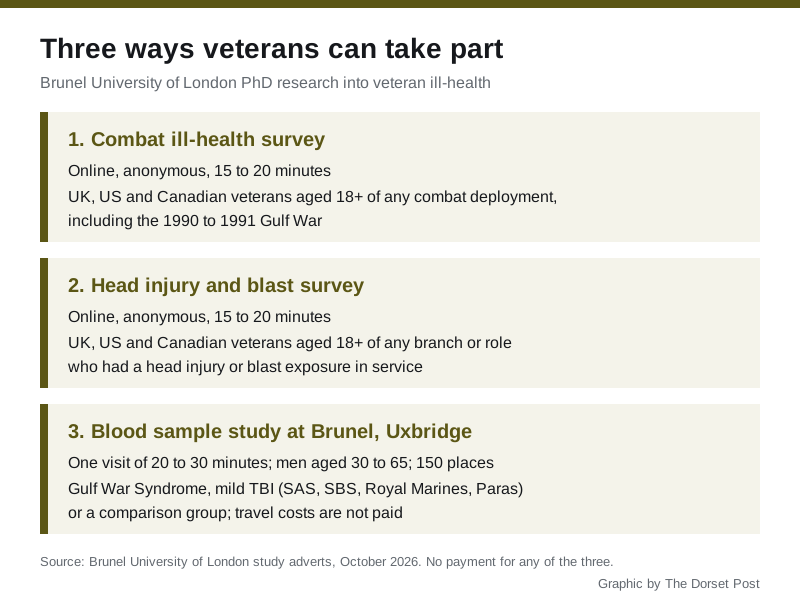
A former soldier now doing a PhD at Brunel University of London is asking military veterans in Dorset and beyond to fill in two anonymous online questionnaires about their health after service, one on combat deployments including the 1990 to 1991 Gulf War and one on head injuries and blast exposure. Each takes 15 to 20 minutes. The same researcher is also looking for 150 men to give a single blood sample at the university for a laboratory study of Gulf War Syndrome and blast-related brain injury.
Savannah Thompson, a doctoral researcher at Brunel, told us the research began after being medically discharged from the British Army. It is “self-proposed and self-funded”, the researcher said, and the study adverts sent to us say it has full ethical approval.
“I am now just needing to recruit people to either partake in the lab work and/or complete one (or both) of the questionnaires,” Savannah Thompson wrote. “I… would really appreciate any help in circulating any of the relevant adverts wherever possible.”
Survey one: health after a combat deployment
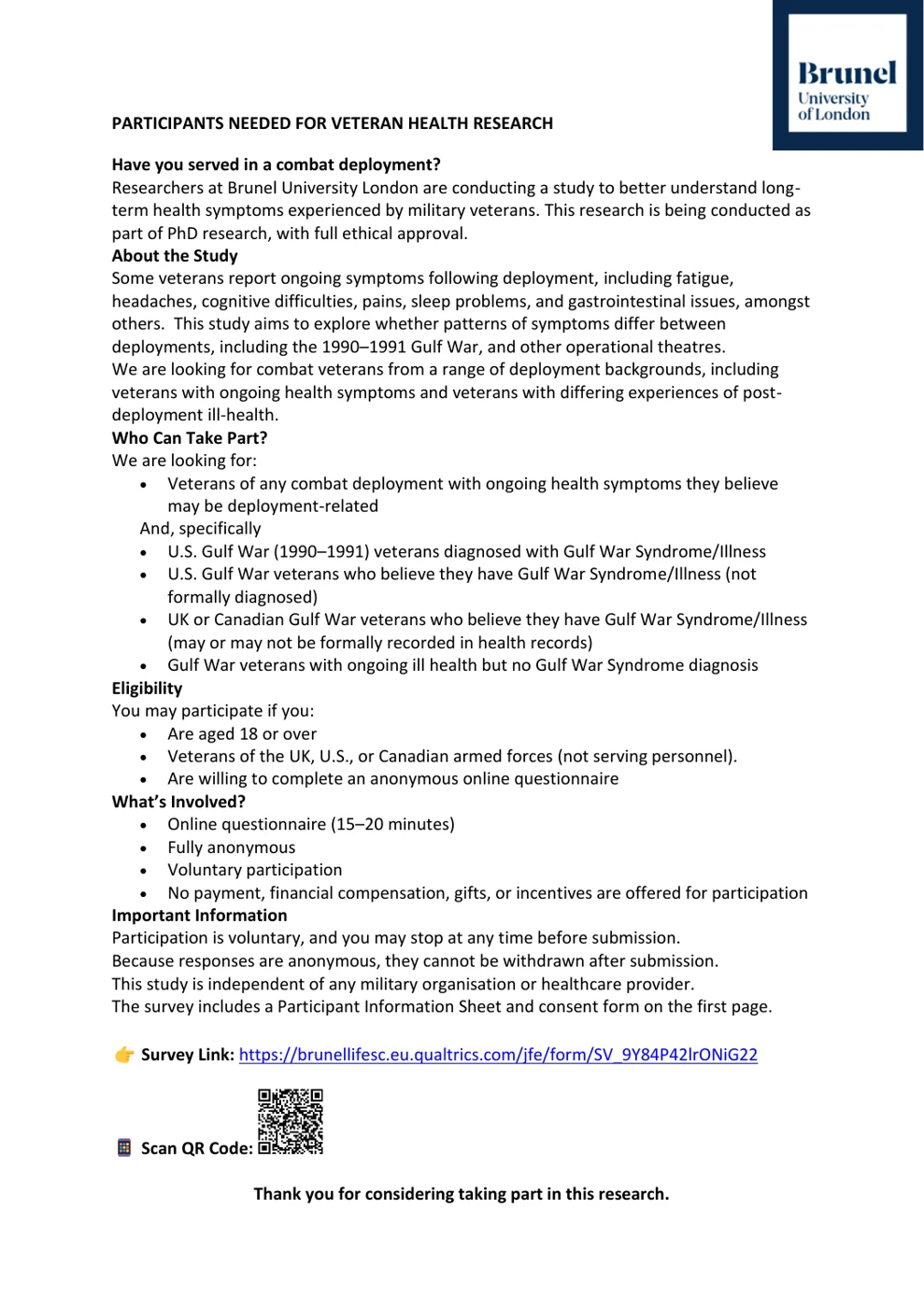
The first questionnaire looks at what Savannah Thompson describes as “post-combat ill-health symptom trajectories by deployment zone”. Its advert says some veterans report ongoing symptoms after deployment, “including fatigue, headaches, cognitive difficulties, pains, sleep problems, and gastrointestinal issues, amongst others”, and the study “aims to explore whether patterns of symptoms differ between deployments”, including the 1990 to 1991 Gulf War and other operational theatres.
It wants veterans of any combat deployment who have ongoing symptoms they believe may be linked to it, and in particular UK Gulf War veterans who believe they have Gulf War Syndrome, whether or not it is recorded in their health records, and Gulf War veterans with ongoing ill health but no such diagnosis. Veterans who served without later health problems are also wanted, to compare.
You can take part if you are 18 or over and a veteran (not serving personnel) of the UK, US or Canadian armed forces.
Start the combat ill-health survey
Survey two: head injury and blast exposure
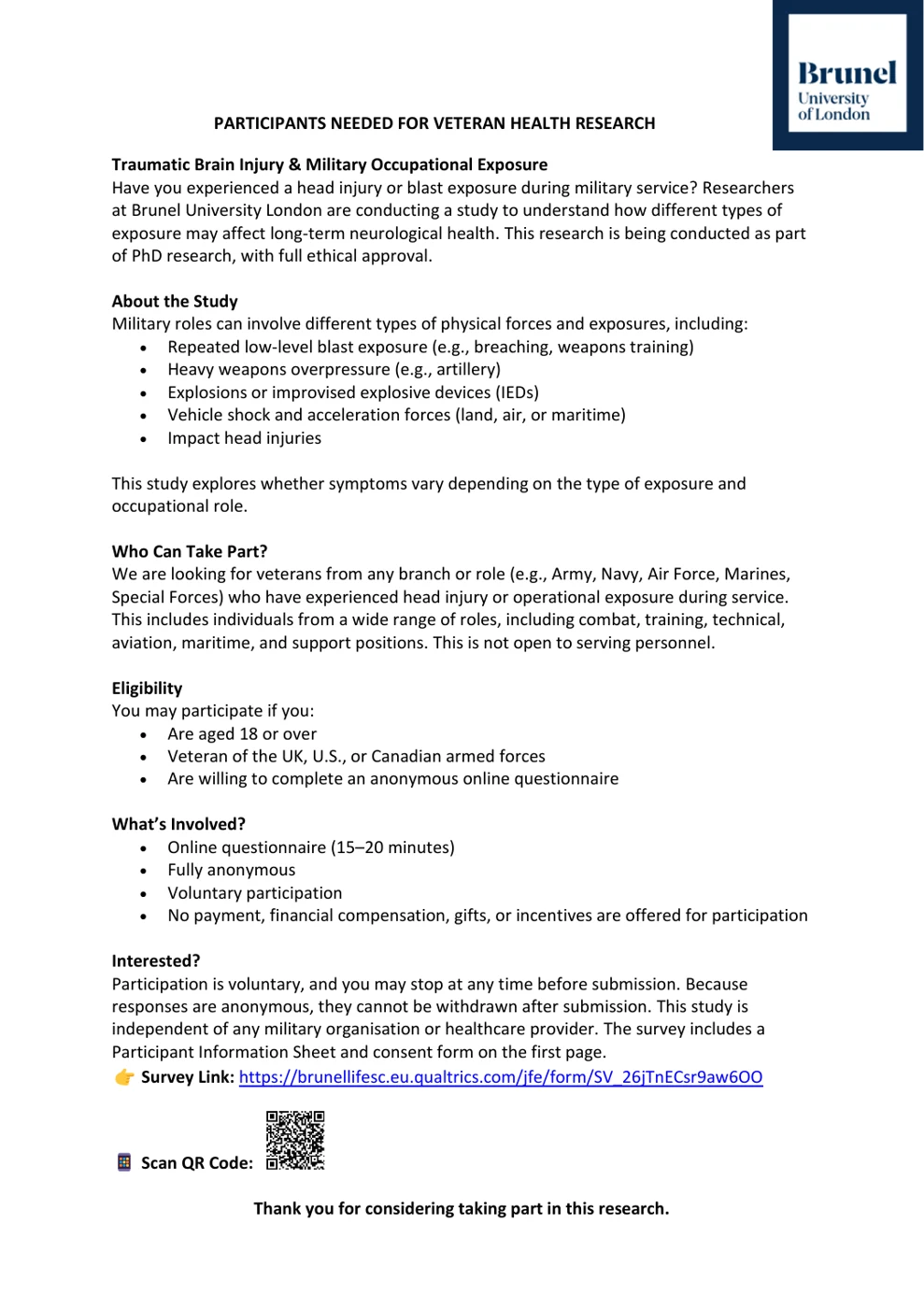
The second questionnaire asks “how different types of exposure may affect long-term neurological health” and whether symptoms vary by the kind of exposure and by job. The exposures it lists are:
- repeated low-level blast, such as breaching and weapons training
- heavy weapons overpressure, such as artillery
- explosions or improvised explosive devices (IEDs)
- vehicle shock and acceleration forces on land, in the air or at sea
- impact head injuries
It is open to veterans “from any branch or role (e.g., Army, Navy, Air Force, Marines, Special Forces) who have experienced head injury or operational exposure during service”, and the advert says that includes “combat, training, technical, aviation, maritime, and support positions”. The same age and service rules apply.
Start the head injury and blast survey
Both surveys are fully anonymous and open with a participant information sheet and consent form. You can stop at any point before you submit, but because answers carry no name they cannot be withdrawn afterwards. The adverts say the study “is independent of any military organisation or healthcare provider”. No payment, gifts or incentives are offered.
The blood sample study
The laboratory study is UK only and looks at what Savannah Thompson calls neuroimmune dysfunction. Its advert says it will explore “whether specific immune pathways involved in detecting cellular stress behave differently across groups of veterans.”
“Many veterans continue to experience long-term symptoms years after service, including those related to Gulf War Syndrome (GWS) and blast-related Traumatic Brain Injury (TBI),” it says. “The underlying biology of these health issues is not well understood, and many veterans have expressed frustration at the lack of clear explanations.”
The study wants 50 men in each of three groups, all aged 30 to 65:
- Gulf War (1990 to 1991) veterans diagnosed with recognised Gulf War Syndrome
- SAS, SBS, Royal Marines or Parachute Regiment veterans with diagnosed or suspected military-related mild traumatic brain injury
- veterans with a deployment history and no Gulf War Syndrome, brain injury or other immune-altering condition, as a comparison group
The visit takes 20 to 30 minutes at Brunel’s campus in Uxbridge: reading the information sheet and signing a consent form, a short symptom questionnaire, and a routine blood sample. There are no follow-up visits. Before it you would be asked to avoid alcohol for 48 hours, smoking or vaping for 12 hours and strenuous exercise for 24 hours, and some medicines and recent illnesses may rule you out.
“You will not be asked to discuss operational experiences or traumatic events,” the advert says. It adds that the study “does not diagnose any condition and will not identify the cause of individual symptoms”, that samples are anonymous, and that taking part or not “will not affect medical care, service records, benefits, or relationships with any organisation”. The project is independent of the MOD, the NHS and service charities.
Travel is not refunded. “As the research is self-proposed and self-funded, I unfortunately don’t have the means to reimburse travel,” Savannah Thompson told us, so the lab work is “likely only useful to local areas”. For Dorset veterans that makes the online questionnaires the practical way in, unless you are travelling to that part of London anyway.
To ask about the blood study, email Savannah Thompson at 2404974@brunel.ac.uk. Savannah Thompson is happy to talk it through on most days, though not on Friday mornings, which are given to volunteering at the coffee morning of a veterans’ care home.
What it means for you
If you served in the UK, US or Canadian forces and have left, either survey takes about a quarter of an hour on a phone or computer, and you need not have a diagnosis to take part. If you know a veteran who would not see this, the adverts can be printed or forwarded: combat ill-health survey advert (PDF) and head injury and blast survey advert (PDF).
Have your say