
Maiden Castle near Dorchester is free and open any reasonable time in daylight. Parking, the 2km rampart walk, dogs among the sheep, mud and what to see.
Maiden Castle, just outside Dorchester, is one of the largest and most complex Iron Age hillforts in Europe, and it costs nothing to visit. English Heritage looks after it and says it is open any reasonable time during daylight hours, with free entry for everyone. There is a small car park at the foot of the fort, no café and no shelter, and the grass is kept down by a flock of sheep, so dogs must stay on a lead.
This page covers how to get there, the walk round the ramparts, what to look for, and what to expect in winter. We checked English Heritage’s Maiden Castle visitor page and its opening times on 12 November 2026.
The essentials
| Address | Maiden Castle Road, Dorchester, DT2 9PP |
| Opening | Any reasonable time during daylight hours |
| Entry | Free for all, including families; donations welcome |
| Parking | Small free car park at the fort, busy at peak times |
| Dogs | Welcome on a lead, because sheep graze the site |
| Facilities | None on site: no toilets, café or shelter |
| Access | Uneven ramparts; not suitable for wheelchairs |
“Daylight hours” is the rule that matters in winter. In mid-November the sun sets in Dorchester before half past four, and the open hilltop is not a place to be finding your way down in the dark.
Getting there
Maiden Castle sits on a long chalk hill under two miles south-west of Dorchester town centre. By car, turn off the A354 Dorchester to Weymouth road onto Maiden Castle Road, the lane that leads to the car park. Use the postcode DT2 9PP. The car park is small and fills on fine weekends and in school holidays; arrive early or late in the day.
On foot, the walk from Dorchester takes you out along Maiden Castle Road; allow 40 minutes or more each way before you start the ramparts. If you want to make a day of it, our walks in Dorset page has other routes in the area.
How big it is, and the walk round the top
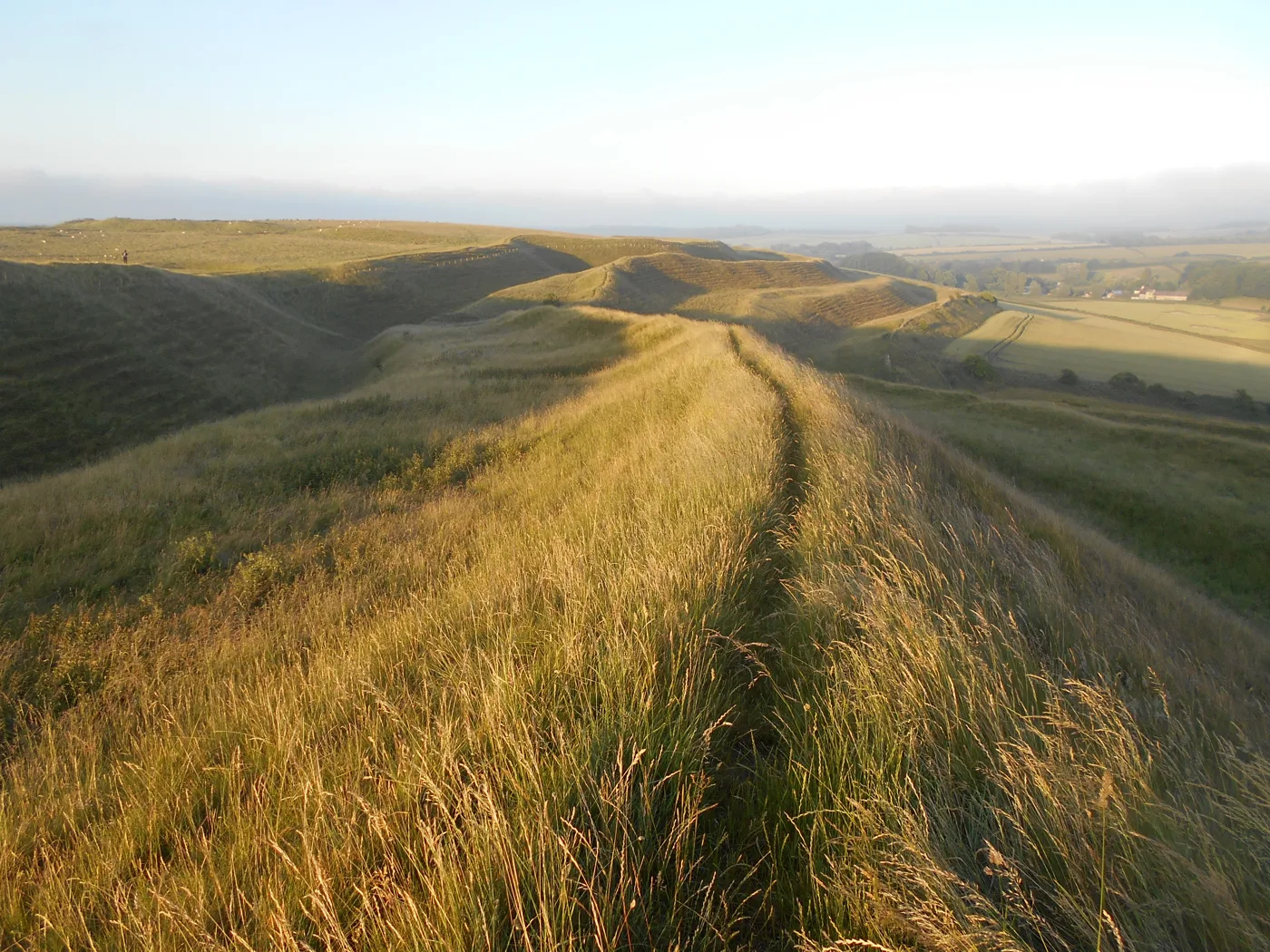
English Heritage describes the fort as the size of 50 football pitches. The inner rampart alone is about 2km (1¼ miles) long, and further banks and ditches ring it on the outside.
The two classic walks are:
- The inner rampart circuit. Climb from the car park through the eastern entrance and follow the top of the inner bank all the way round. It is about 2km and takes most people around an hour with stops. The views run across Dorchester and the surrounding downs.
- A ditch walk. Drop into the deep ditches between the outer ramparts, which shows the scale of the earthworks far better than the top does. It is steeper and muddier.
The paths have been worn by walkers over the years rather than laid, and English Heritage warns that in places the chalk is exposed, making an uneven, slippery surface. Wear boots with grip, especially from autumn to spring when the chalk turns greasy in rain. The hilltop is completely exposed, so take a windproof layer even on a mild day in town.
What to look for
Maiden Castle is not one monument but several, built on the same hill over about 5,000 years. English Heritage’s history of Maiden Castle sets out the sequence:
- The Neolithic hilltop, about 5,500 years ago. Early farmers built a causewayed enclosure at the eastern end of the hill, a gathering place ringed with banks and ditches. About a century later came a “bank barrow”, a mound 546 metres long running along the spine of the hill, now almost ploughed flat. A Neolithic long barrow overlooks the car park.
- The first hillfort, over 2,600 years ago. A single rampart and ditch at the eastern end enclosed an area the size of ten football pitches. Its western rampart and gateway can still be traced inside the later fort.
- The great hillfort, from about 2,400 years ago. The defences were pushed west to take in three times the area, and over the next 300 years extra ramparts were added and the gateways made ever more complex. At its peak there were more than 100 roundhouses inside. Pits by the gateways held thousands of beach pebbles used as sling shot.
- The gateways. The winding entrances at each end forced anyone approaching into long, narrow passages between the banks. Walk through the western entrance to feel how it works.
- The Roman temple footings. Around AD 370, long after the fort was abandoned, a Romano-British temple was built inside the ramparts. Its low stone footings are still visible on the hilltop: a central room about 5 metres square with a walkway around it, and a two-roomed building beside it that may have been the priest’s house. A bronze plaque of Minerva found here suggests who it was dedicated to.
- The dewpond. A square, clay-lined pond dug for sheep in the 1860s, because there is no water on the hilltop.
The “war cemetery”
The most famous story about Maiden Castle comes from Mortimer and Tessa Wheeler’s excavations of 1934 to 1937. In the eastern gateway they found a cemetery in which a cluster of 34 late Iron Age skeletons showed terrible injuries, and Mortimer Wheeler read it as the aftermath of a Roman assault in AD 44. English Heritage now says that was almost certainly not the case: the dead were buried carefully, with grave goods, by their own people, and radiocarbon dating suggests the burials may have happened over a period rather than after one battle. Many of them do seem to have lived violent lives. Finds from the excavations can be seen at Dorset Museum in Dorchester.
Sheep, dogs and the missing information panels
The sheep are there on purpose: grazing keeps the grass short and stops scrub from damaging the earthworks. They have also damaged the site’s interpretation panels, and English Heritage says it is still looking for a sheep-proof replacement. Until then, the best way to understand what you are standing on is English Heritage’s free digital guide on the Bloomberg Connects app, or its Echoscape audio experience. Download the guide before you leave home.
Keep dogs on a short lead the whole time you are inside the ramparts, and pick up after them. Smoking, vaping, barbecues and any naked flames are banned, and there are rules on flying drones; English Heritage publishes its drone guidance separately.
Guided tours
Occasional guided tours of Maiden Castle are run by Dorset Museum & Art Gallery, and booking is essential. The last tour English Heritage listed was in August, so check the museum’s events listings for the next date.
Combine it with
- Dorchester. The Roman town of Durnovaria was founded nearby in about AD 70, after Maiden Castle had been abandoned. Dorset Museum is the natural next stop.
- Other English Heritage sites close by, according to its own listing: the Nine Stones circle and Jordan Hill Roman Temple near Weymouth, each about four miles away; and Winterbourne Poor Lot Barrows, a group of 44 Bronze Age burial mounds south of the A35, about five miles.
- The coast. Portland Castle and Chesil Beach are a short drive south; see our pages on Chesil Beach and Portland Bill.
- The Cerne Abbas Giant, another chalk hill monument north of Dorchester: our Cerne Abbas Giant guide has the viewpoint and parking.
For more ideas, see days out in Dorset and things to do in Dorset.
Frequently asked questions
Is Maiden Castle free to visit? Yes. English Heritage lists entry as free for everyone, members and non-members alike, and parking at the small car park is free too.
What are Maiden Castle’s opening times? English Heritage says it is open any reasonable time during daylight hours, every day. In winter that means leaving before dusk, which falls before 4.30pm in mid-November.
Can you take dogs to Maiden Castle? Yes, on a lead. Sheep graze the hillfort to keep the grass down, so dogs must be kept under close control throughout.
How long does it take to walk round Maiden Castle? The inner rampart is about 2km (1¼ miles) long. Most people take about an hour to walk round the top, longer if they drop into the ditches or explore the gateways.
Is Maiden Castle suitable for wheelchairs or pushchairs? No. English Heritage says the ramparts are uneven and not suitable for wheelchairs, and the steep, worn chalk paths are hard going with a pushchair.
Are there toilets at Maiden Castle? No. There are no facilities on site, so plan to use them in Dorchester before or after your visit.
Have your say